You plump them up, line them along the back, and within an hour they’ve slumped into a sad heap in the corner. Sound familiar? Getting cushions on sofa backs to look relaxed but deliberate is one of those small styling skills that makes a big difference to a living room.
There’s no single right answer, but there are a few simple rules that work every time. Once you know them, you can arrange cushions on any sofa in about two minutes.
Start with your sofa, not the cushions
Before buying anything, take a good look at your sofa. Its size, shape and back height decide how many cushions it can take and how big they should be.
- Low-backed, modern sofas suit smaller cushions, otherwise they cover the whole back and look cluttered.
- High-backed or traditional sofas can take larger cushions, which fill the space and look more generous.
- Deep seats often need a cushion behind you just to make sitting comfortable, so think about comfort as well as looks.
- Busy upholstery (patterned or textured) works best with plain cushions, and a plain sofa gives you more freedom to use pattern.
Measure the back height of your sofa from the seat to the top. As a rough guide, your largest cushions should sit a little below the top of the back, not poke up above it.
The golden rules for cushions on sofa styling
These are the rules stylists come back to again and again. You don’t have to follow every one, but they’re a reliable starting point.
Odd or even?
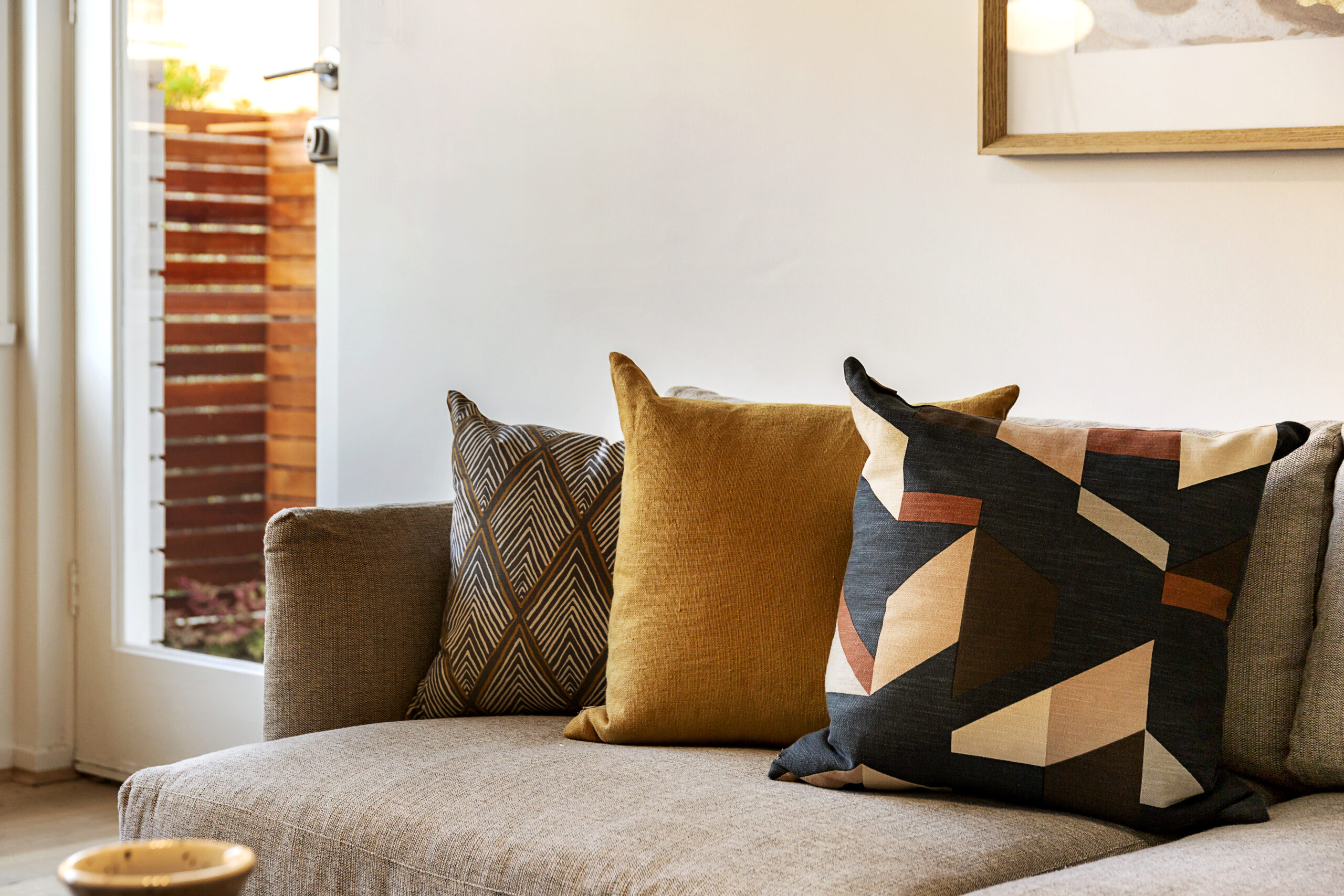
Even numbers (two or four) give a calm, symmetrical, traditional look. Odd numbers (three or five) feel more relaxed and modern. Neither is wrong; it’s about the mood you want.
Big at the back, small at the front
Always layer from largest at the back to smallest at the front. It gives depth and stops the smaller cushions disappearing.
Mix sizes, shapes and textures
A row of identical cushions can look a bit showroom. Mixing a couple of sizes and textures (velvet with corduroy, or a smooth cotton with something chunkier) adds interest without needing loud colours.
Leave room to sit
It sounds obvious, but a sofa should still be usable. If you have to move four cushions every time you sit down, there are too many.
How to arrange cushions on a sofa, by size
Here’s how to arrange cushions on a sofa depending on its size. Use it as a template and swap things around until it looks right to you.
Two-seater sofa
Two or three cushions is plenty. Try a matching pair at each end, or a pair plus one smaller accent cushion off to one side for a more casual look.
Three-seater sofa
Four or five cushions work well. A popular option is the “2-2-1” arrangement: two large matching cushions at each end, two slightly smaller ones layered in front of them, and one statement cushion in the middle.
Corner sofa
Treat the corner as its own focal point. Put two or three cushions into the corner, layered by size, then one or two at each end. Avoid lining cushions all the way along, which makes a corner sofa look endless.
Cushion size guide
Cushion sizes are usually given in centimetres, with inches in brackets on most UK listings. Here’s a simple cushion size guide to help you mix them well.
| Cushion size | Best used for |
|---|---|
| 30 x 30cm (12in) | Small accent cushions, armchairs, front of a layered arrangement |
| 40 x 40cm (16in) | Low-backed sofas, armchairs, the middle layer |
| 45 x 45cm (18in) | The most common size; works on most standard sofas |
| 50 x 50cm (20in) | Statement or back-row cushions on standard and larger sofas |
| 60 x 60cm (24in) | Big back-row cushions on deep or high-backed sofas and corner sofas |
The inner pad trick
For that plump, full look, many stylists use a cushion pad slightly bigger than the cover, often one size up. A pad that’s exactly the same size as the cover tends to look flat and floppy, especially once it’s settled. For example, a 45 x 45cm pad inside a 40 x 40cm cover gives a much fuller, firmer shape.
Choosing scatter cushions: colour, pattern and texture
Scatter cushions are the easiest way to change the look of a sofa without changing the sofa. A few pointers keep them looking pulled together.
Pick a palette of three. Choose one main colour, one supporting colour and one accent. Pull them from things already in the room, like a rug, curtains or artwork.
Vary the scale of pattern. If you’re using more than one pattern, mix a large print with a smaller one, and add plain cushions in between to give the eye a rest.
Lean on texture. Velvet, corduroy, chenille and pompom trims all add depth, even in neutral colours. A sofa in all-cream cushions can look lovely if the textures are different.
Should sofa cushions match? Not exactly. Matching pairs bring order, but one or two cushions that are a little different stop things looking flat.
Sofa cushions for comfort, not just looks
Sofa cushions do have a practical job too. If your sofa is deep, a large, firm cushion behind your back can make it far more comfortable to sit on. Feather pads squash and mould nicely but need regular plumping; hollowfibre pads hold their shape and suit anyone with allergies to feathers.
Removable covers are a big plus, as you can wash them or swap them with the seasons. Always check the care label first.
Our picks for cushions
We’ve picked a handful from our range that work together in different combinations:
- The base layer: the SK Merchandise pack of 4 hollowfibre cushion pads in 45 x 45cm. They’re anti-allergy, and they also work as a plump filling for 40 x 40cm covers.
- Soft neutrals: the Topfinel cream corduroy cushion covers, a set of two in 45 x 45cm. Corduroy adds a lovely texture without shouting.
- Statement back row: the MIULEE velvet cushion covers in a generous 60 x 60cm size, with an invisible zip.
- A pop of colour: the Homefeelzydys green velvet cushion covers, a set of four in 45 x 45cm.
- Playful texture: the Ragged Rose pompom velvet cushion covers at 50 x 50cm, with a zip fastening.
- Small accent: the Stylo Culture peacock jacquard cushion cover at 30 x 30cm, perfect for the front row.
For a three-seater, try the MIULEE velvet at the back of each end, the Topfinel corduroy in front, and the Stylo Culture jacquard in the middle. Browse more in our cushions and scatter cushions range.
The finishing touches
A couple of tiny habits keep things looking good:
- Plump daily. A quick squeeze and shake each evening brings the filling back to life.
- The “chop” is optional. That karate-chop dent in the top of a feather cushion looks smart in a formal room, but can feel a little try-hard in a relaxed one.
- Add a throw. A throw over one arm or the back corner softens the look and balances the cushions. Our guide on how to style a throw on a sofa shows a few easy ways to do it.
Cushions on sofa: your questions answered
What is the rule for cushions on a sofa?
There isn’t one strict rule, but the most useful guidelines are: layer from large at the back to small at the front, mix a couple of sizes and textures, and keep enough room to sit. Odd numbers feel relaxed, while even numbers look more formal.
What is the 2-2-1 rule for sofas?
It’s a five-cushion arrangement for a three-seater. You put two large matching cushions at the ends, two smaller ones in front of them, and one statement cushion in the centre. It’s balanced but not too stiff.
How many cushions look best on a sofa?
For a two-seater, two or three. For a three-seater, four or five. For a corner sofa, five to seven, grouped in the corner and at the ends rather than spread evenly.
What is the best cushion filling for a sofa?
Feather fillings feel luxurious and squash nicely, but need plumping. Hollowfibre is lighter, holds its shape and is a good choice for allergy sufferers. Whatever you choose, a pad slightly bigger than the cover looks fuller.
Can I wash my sofa cushion covers?
Many covers are machine washable, especially those with zips, but always check the care label first. Velvet and pompom trims often need a gentle cycle or hand wash. Washing covers inside out helps protect the colour and texture.
Styling cushions on sofa backs gets easier the more you play with it, so don’t be afraid to move things around until it feels right. For more inspiration, have a look around our living room collection, or see our small living room ideas if you’re working with a compact sofa.