Most living rooms have one big light in the middle of the ceiling, and most of us switch it on at dusk and wonder why the room feels like a waiting room. Good living room lighting isn’t about buying one brilliant fitting. It’s about layering a few modest ones so you can change the mood with a couple of switches.
This guide walks through the three layers designers use, where each one goes, and how to put them together on a sensible budget. We’ve also picked a handful of lights from our own range that do each job well, so you can see how the ideas look in real life.
Why living room lighting works best in layers
Your living room does more jobs than any other room in the house. It’s where you watch telly, read, chat, help with homework, fold washing and fall asleep halfway through a film. One light simply can’t suit all of that.
Designers get round this by splitting light into three types:
- Ambient light: the general, all-over glow that lets you see the room. Usually from the ceiling.
- Task light: focused light for something specific, like reading or a puzzle on the coffee table.
- Accent light: softer pools of light that pick out corners, shelves or artwork and make the room feel cosy.
When you have all three, you rarely need the big ceiling light on in the evening at all. That’s the real secret. The rest of this guide is just about choosing and placing each layer.
Lighting for living room ceilings: your ambient layer
Lighting for living room ceilings sets the baseline. It needs to be bright enough for cleaning, hoovering and finding the TV remote, but it shouldn’t be the only thing you rely on.
Pick the right type for your ceiling height
If you have standard or high ceilings, a pendant or a multi-arm fitting adds character and spreads light well. The MiniSun 3-way brushed chrome ceiling fitting is a good example: three frosted glass shades soften the bulbs and throw light in a few directions rather than one harsh spot.
Low ceilings are common in UK terraces, cottages and new builds, and a dangling pendant can feel like it’s about to clip your head. A flush or semi-flush fitting keeps everything tight to the ceiling. The Goeco LED ceiling light sits close to the ceiling and, going by its listing, gives you a choice of 3000K, 4500K and 6500K colour temperatures, so you can keep it on the warmer setting for evenings.
Swap the shade before you swap the fitting
If you’re renting or don’t fancy calling an electrician, changing the shade is the cheapest upgrade going. A dark shade with a metallic lining pushes light down and gives a warmer glow. The GIGGI black ceiling shade with gold inner is an easy-fit option that works on a pendant, table lamp or floor lamp. You’ll find more in our lamp shades collection.
Fit a dimmer if you can
A dimmer switch on the ceiling light is one of the best value lighting ideas for living rooms. Just check your bulbs are labelled dimmable, as standard LEDs can flicker or buzz on a dimmer.
Floor lighting: living room corners that need a glow
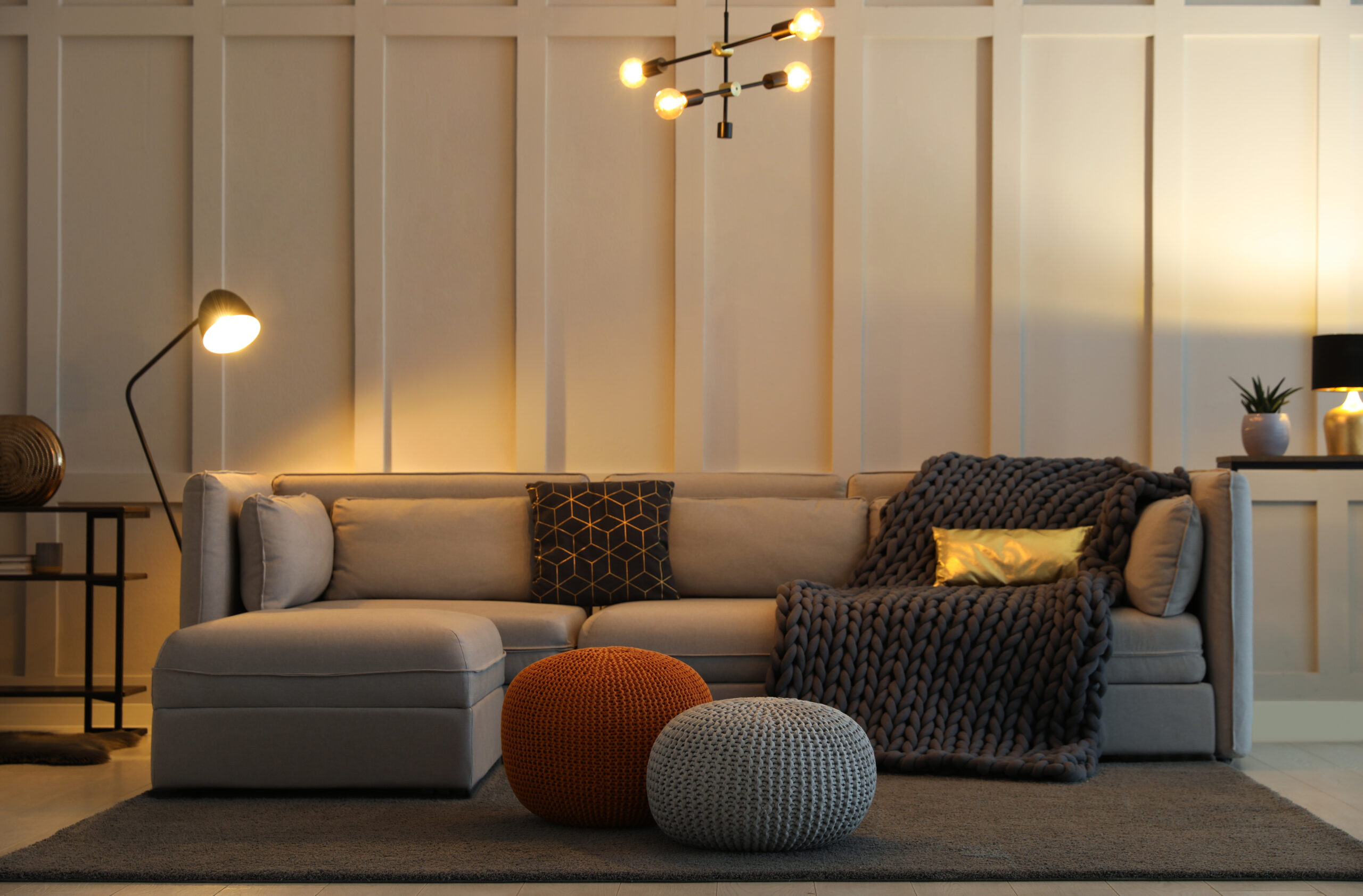
Floor lighting in the living room is the workhorse of the evening. A floor lamp in a dark corner bounces light off two walls at once and instantly makes the room feel bigger and warmer.
There are three main styles worth knowing:
- Shaded floor lamps give a soft, diffused glow and suit traditional and modern rooms alike.
- Tripod lamps have a wider footprint and a more relaxed, Scandi feel.
- Adjustable or task floor lamps have heads you can angle, which makes them great beside a reading chair.
We like the MiniSun antique brass barley twist floor lamp for a classic look; its listing says it comes with a 3000K warm white LED bulb, which is the colour you want for a cosy evening. For something more modern, the OUTON wooden tripod floor lamp is dimmable, comes with a remote and has a small storage shelf, which is handy if you’re short on side tables.
Browse the full range of floor lamps for the living room if you want more styles.
Task lighting: reading, crafts and homework
Task light is about putting light exactly where your eyes need it. The rule of thumb is to position it to the side and slightly behind you, so the light falls on the page rather than in your face or across the TV screen.
An angled floor lamp is the easiest way to do this. The LALISU industrial floor lamp has adjustable metal heads, so you can point one at your book and the other at the wall for a softer bounce.
Table lamps do task duty too, especially on a side table next to the sofa. If you’re not sure what size or shade to go for, our guide on how to choose a table lamp covers heights, shades and bulbs in detail.
Wall lighting: living room ideas for any budget
Wall lighting in the living room is often overlooked, but it’s brilliant for washing light up or down a chimney breast, either side of a mirror, or above a sofa. It adds a middle layer between the ceiling and the floor, which is what makes a room look properly finished.
Hardwired wall lights need an electrician and some replastering, so they’re best done during a bigger redecoration. If that’s not on the cards, plug-in wall lights with a neat cable cover are a renter-friendly alternative. You can also cheat the effect with a floor lamp pointed at the wall, or a table lamp placed against it on a console.
Whichever route you take, aim for warm white bulbs and keep wall lights at a height where you can’t see straight into the bulb when you’re sitting down.
Accent lighting: the cosy layer
Accent lighting is the fun bit. It’s the small pools of light that make the room feel lived-in rather than lit.
A few easy ideas:
- A small table lamp on a bookshelf or the end of a sideboard.
- A cordless, rechargeable lamp you can move around, onto the coffee table for a film night or the windowsill in winter.
- A pair of matching lamps either side of the sofa for a calm, symmetrical look.
The OUTON rechargeable cordless table lamp is a clever option here because you’re not tied to a socket. For a more classic accent, the MiniSun antique gold touch table lamp with cream shade is a simple, tap-to-switch-on lamp that looks right on almost any side table. See all our table lamps for more.
Getting the colour of light right
The colour temperature of a bulb is measured in kelvin (K), and it makes a bigger difference to the feel of a room than the fitting itself.
| Colour temperature | What it looks like | Best used for |
|---|---|---|
| 2700K to 3000K | Warm white, slightly golden | Evenings, lamps, accent lighting |
| 3500K to 4500K | Neutral white | General ceiling light, daytime tasks |
| 5000K to 6500K | Cool white, bluish | Garages, utility rooms, close detail work |
For living room lighting, stick to warm white for anything you’ll use in the evening. Try to keep all the bulbs in the room roughly the same temperature too, as mixing warm and cool lights tends to look patchy.
Our picks for layered living room lighting
If you want a simple starting kit, here’s how our picks fit together:
- Ambient: MiniSun 3-way brushed chrome ceiling fitting for standard ceilings, or the Goeco LED ceiling light for low ones.
- Floor: the OUTON wooden tripod floor lamp in the darkest corner.
- Task: the LALISU industrial floor lamp beside your reading chair.
- Accent: the MiniSun antique gold touch table lamp on a side table, plus the OUTON cordless table lamp to move wherever you need it.
- Quick upgrade: the GIGGI black and gold shade on an existing pendant.
Start with the floor lamp. Of all the layers, it’s the one that changes the feel of a room fastest.
Living room lighting FAQs
What is the best type of ceiling light for a living room?
It depends mostly on ceiling height. For standard and high ceilings, a pendant or multi-arm fitting adds character and spreads light well. For low ceilings, a flush or semi-flush fitting keeps headroom clear. Either way, pair it with lamps so it isn’t doing all the work.
How low should a pendant light hang in a living room?
In an area people walk through, a common guide is to keep the bottom of the pendant at least 2 metres (about 6ft 6in) from the floor. Over a coffee table or in a corner where nobody walks, you can hang it lower for a cosier feel.
Can I use a pendant light in a living room with a low ceiling?
You can, but choose a compact shade and keep the drop short, or hang it over a spot where nobody walks, like above a side table or in a corner. Otherwise, a semi-flush fitting gives you a similar look without the head-bumping.
How many lights should a living room have?
There’s no fixed number, but aim for at least three or four light sources at different heights: a ceiling light, a floor lamp and one or two table lamps. Spread them around the room so no corner is left in the dark.
What colour bulb is best for a living room?
Warm white, around 2700K to 3000K, is the usual choice for living rooms. It gives a soft, golden light that feels relaxing in the evening. Save cooler white bulbs for kitchens, utility rooms and workspaces.
Good living room lighting is less about spending a lot and more about adding layers one at a time. Pick a floor lamp this month, a table lamp the next, and you’ll soon wonder how you lived with just the big light. For more ideas, have a look around our living room collection, or read our small living room ideas if you’re working with a compact space.